




ICT can offer both laboratory and production line machinery as for SKF standards
Control of bearing noise can be performed basically through 3 different measurement methods:
- By Acceleration (dB), often used by bearings manufacturers in Japan and in China;
- By Displacement (µm), basically NOT used anymore (in the past it was popular in Germany);
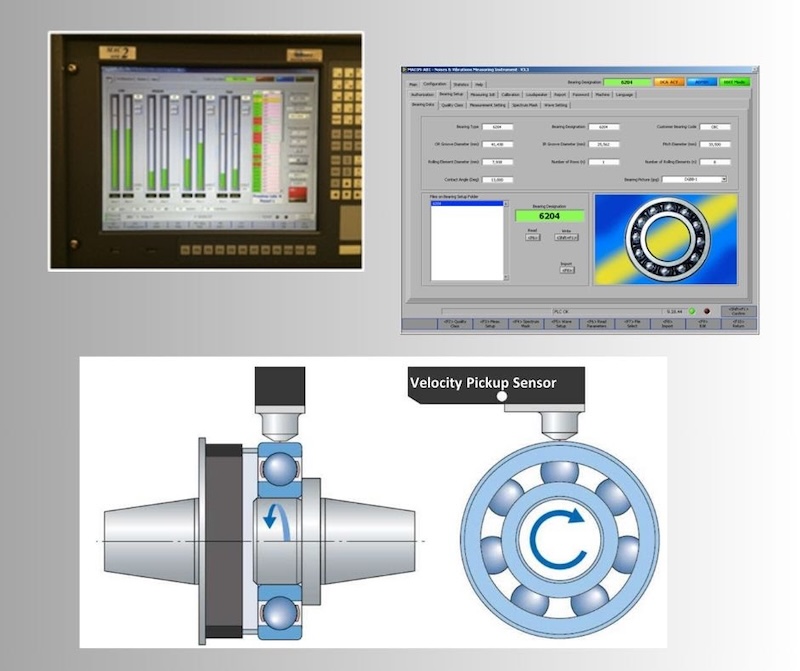
- By Velocity (µm/sec), as for SKF bearings noise technology.
 While the noise measurements in dB have the great disadvantage NOT to be in grade to measure with appropriate accuracy the bearing noise responses at medium and – above all – at low frequencies, so highlighting only potential defects (like rings races or rolling elements inaccurate finish rate) at high frequencies, the displacement method has basically the opposite problem, i.e. to increase the focus on basic geometrical errors of bearing components and not “to look at all” on high frequencies band.
The velocity approach was developed many years ago by SKF to overcome the problems of the other two methods. The noise measurement in velocity (µm/sec) of the pick-up of special sensor is transformed in root mean square values of different bands (Low, Medium and High bands, from 50 to 10000 Hz) and – through the enveloping algorithms – makes possible the evaluation of sudden and not repetitive defects (so called Peaks) due for instance to local defects on rings raceways or on rolling elements. Such defects would never be detected by frequency analysis. Furthermore, the velocity approach guarantees a satisfactory resolution in measurement in the whole range of analysis, and not only in high frequencies range (like it happens with dB) or in low frequencies band (as it happens with µm), so increasing the possibility to detect all types of products non conformities.
Elite can offer the Italian technology of noise measurements machines in velocity, both for laboratory equipment and for production line (with automatic loading/un-loading and double side control of bearings). The machinery is capable to present the statistical analysis of all defects and of the potential reasons of bearing noise, in order to address the operators and technicians to the right point of process to be checked and improved.
Furthermore, the possibility to set-up customized spectrum masks with limits in addition to the traditional L, M and H bands allows to sort out specific types of bearing defects that otherwise would not be detected. Typical example is the case of “bearing tone” of DGBB that can be heard by loudspeaker but that is normally not reflected in root mean square values at frequencies analysis.
We can also provide the velocity pick-up sensors (MEA 12) as well as the equipment for the periodical calibration of pick-up at the different testing frequencies.
For more info about ICT Srl products offer for bearing noise equipment, please get in touch writing to info@consulting-trading.com or calling at +39 (0)121 376811.