



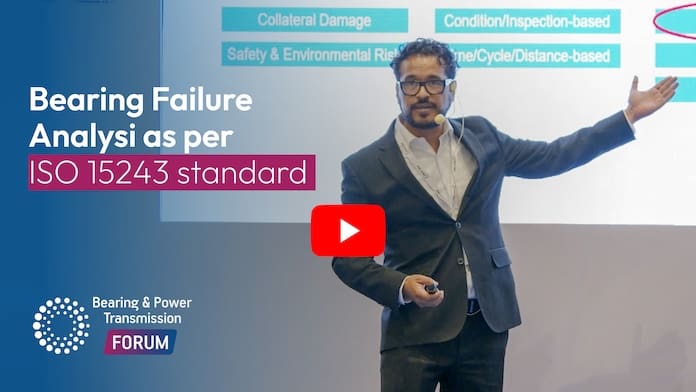
Reliability is the true currency of modern industry, and bearings play a central role in safeguarding it. During his presentation titled “Bearing Failure Analysis as per ISO 15243 Standard” at the Bearing & Power Transmission World Meetings 2025, Alejandro Perez Martinez explored how understanding failure modes is essential not only for maintenance teams, but for overall operational sustainability and business performance.
Across industries, bearings are often viewed as replaceable components rather than strategic assets. Yet failures rarely stem from the bearing itself. Misalignment, contamination, improper lubrication, and incorrect installation remain the leading causes of premature damage, most of them rooted in human practices rather than material defects. As Martinez highlighted, even a perfectly manufactured bearing can fail long before its expected life cycle due to cultural habits on the shop floor, such as mounting with hammers or over-greasing equipment without measurement.
This points to a broader issue: reliability is not achieved through components alone, but through people, processes, and precision maintenance. Many failures originate during installation or storage, long before machinery begins operation. Bearings kept in poor warehouse conditions, exposed to vibration or contaminants, may already be compromised before use. Similarly, the absence of maintenance involvement during commissioning often leads to avoidable failures months later.
Precision practices such as proper alignment and contamination control significantly extend bearing life. Misalignment alone can increase load stress by more than 20%, reducing lubrication film strength and accelerating wear. In many cases, adding grease, often seen as a universal fix, worsens the situation rather than solving it.
The environmental and economic implications are equally significant. Each year, billions of bearings are replaced preventively, even when condition monitoring indicates they are still operational. This leads to unnecessary waste, increased energy consumption, and avoidable environmental impact. With electric motor-driven systems accounting for nearly half of global electricity usage, improving reliability through better maintenance culture presents a powerful opportunity for cost savings and sustainability.
Ultimately, achieving reliable machinery requires reliable people. Training, awareness, and cultural transformation, rather than technology alone – are the decisive factors in extending equipment life and preventing costly downtime.
Continue the conversation on reliability, maintenance excellence, and industry best practices at the Bearing & Power Transmission World Meetings 2026 in Dubai. Join global experts, manufacturers, and distributors to explore the strategies shaping the future of our industry. Visit www.bearing-power.com and secure your place.