



Schaeffler, long known as a global supplier of bearings and automotive components, is undergoing one of the most sweeping transformations in its history. The company’s financial results for the first half of 2025, and its newly announced strategic goals reveal a business reshaping itself in response to global industrial shifts.
Schaeffler reported €11.8 billion in revenue for January–June, a 2.6% year-on-year decline on a comparable basis. However, its EBIT margin before special items held steady at 4.1%, masking the deeper restructuring underway within the company.
Betting Big on Electrification
The group is making an aggressive push into electrification, even as its E-Mobility division remains loss-making. The segment grew 9.7% to €2.4 billion, but posted a steep -19% EBIT margin. Still, its order book reached €4.6 billion, reflecting strong demand, particularly in Europe and the Americas as production of new electric models ramps up.
A cornerstone of this strategy is the integration of Vitesco Technologies, a major producer of electric powertrain components. The merger is intended to lift the E-Mobility division to break-even by 2028, positioning Schaeffler as a major player in the global shift toward electric propulsion.
Pivot Beyond Automotive: Defense, eVTOL, and Humanoid Robots
Electrification is only one part of the company’s broader reinvention. Schaeffler is deliberately expanding into non-automotive sectors, aiming to boost their share of revenue from just 1% today to 10% by 2035.
The company has identified three high-growth areas:
- Defense industry, aligning with rising military spending across Europe, where Volkswagen and Daimler Truck have also begun securing new contracts.
- Electric vertical-takeoff aircraft (eVTOL), an emerging market with demanding engineering requirements.
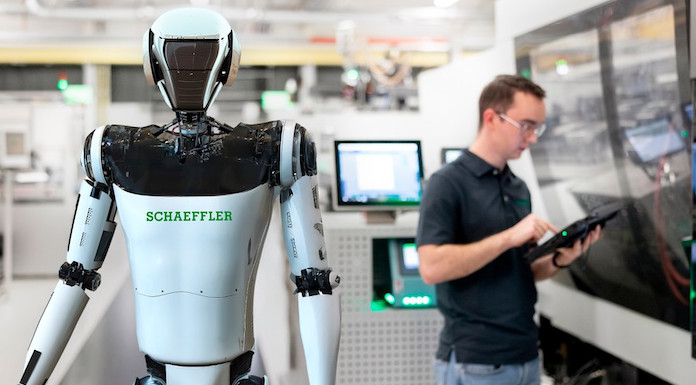
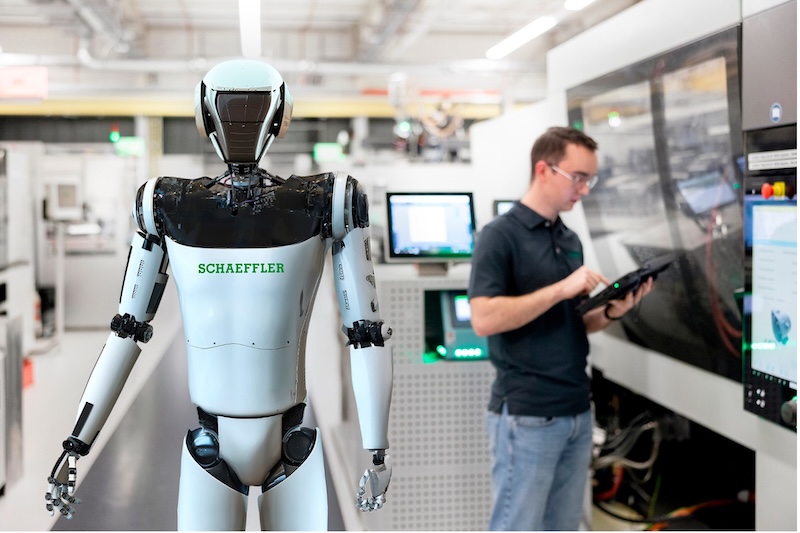
- Humanoid robotics, the most striking addition, where Schaeffler seeks to become Europe’s leading supplier of actuators for human-like robots and is openly searching for strategic partners.
This diversification marks a significant departure from the company’s traditional automotive identity.
Cost Discipline as the Engine of Transition
To support the strategic pivot, Schaeffler is implementing strict cost controls. The decline in demand for internal combustion engine components in Europe, where the Powertrain & Chassis division saw revenue drop 9.1% is being offset by stronger performance in:
- Automotive Aftermarket: +6.3% revenue, 15% margin
- Industrial Division: 7.9% margin
By 2029, the company expects to generate €815 million in additional EBIT through merger synergies and a comprehensive cost-reduction program, which includes the planned reduction of 4,700 jobs in Europe.
Challenges Ahead
Risks remain considerable: weakening demand in China and Europe, a high net debt of €5.3 billion, and the complexity of fully integrating Vitesco. Nevertheless, Schaeffler maintains ambitious targets aiming for €27–29 billion in revenue and an EBIT margin of 6–8% by 2028.
A New Industrial Identity
Schaeffler’s evolution suggests a shift from an automotive supplier into a diversified technology group, where bearings coexist with robotic actuators and traditional components sit alongside defense-industry contracts. The company’s ability to balance the decline of legacy automotive markets with the monetization of futuristic technologies will determine the success of this transformation. For now, Schaeffler appears committed to its metamorphosis, an industrial chameleon adapting to a rapidly changing world.